
 by
by Synthetic Influencers Go Mainstream: Inside the AI Brand Ambassador Boom
Lil Miquela — the CGI Instagram star who “debuted” in 2016 — is still posting in 2026, still getting nosebleeds on set, and still landing brand deals. But she’s no longer a novelty. She’s now one of thousands of fully synthetic spokespeople brands are deploying at scale, and the industry around her has ballooned into a business worth billions. What started as a curiosity is now a standard line item in marketing budgets, complete with its own ROI benchmarks, its own regulatory regime, and its own consumer backlash.
The New Faces of Marketing
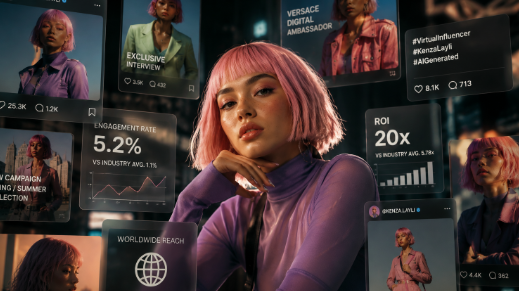
Brands have stopped borrowing virtual influencers and started building their own. Hyundai created Kenza Layli, a multilingual digital avatar, to launch the Kona rather than sign a traditional celebrity endorsement. The payoff was steep: Hyundai reports roughly 20x ROI on the campaign — about $20 in returns per $1 spent, against an industry average closer to $5.78 — while generating and localizing content across eight languages in real time, without the production delays or logistics costs of flying in human talent.
L’Oréal took a similar bet with Kyra, a digital persona positioned as a long-term brand ambassador rather than a one-off stunt. Kyra has racked up 100 million views and a roughly 5% engagement rate, well above typical benchmarks for celebrity-tier influencers, aided by AI sentiment analysis that lets the brand tweak her tone and content in near real time to stay culturally relevant.
Beyond corporate-owned mascots, independent AI personas like Aitana Lopez and Shudu continue booking fashion and beauty campaigns, while Brazilian retailer Magazine Luiza’s virtual spokesmodel Lu do Magalu remains one of the highest-earning digital creators in Latin America. The throughline: brands increasingly prefer characters they fully own and control over creators who can quit, get canceled, or say the wrong thing on a live stream.
The Numbers Brands Can’t Ignore
The financial case is why adoption has accelerated so fast. The virtual influencer market was valued at roughly $8.3 billion in 2025, up about 37% year-over-year from $6.06 billion in 2024, with some projections putting it near $154.6 billion by 2032. More than 60% of brands say they’ve already worked virtual influencers into a campaign, and 71% believe AI-driven personas deliver better ROI than human creators, largely because there’s no travel, no scheduling conflicts, and no risk of a scandal derailing a campaign mid-flight. Some marketers project that by the end of 2026, CMOs will be routing roughly 30% of influencer budgets toward synthetic personalities.
Engagement data backs up the enthusiasm on the supply side: professional virtual influencer campaigns are reporting engagement rates up to ten times higher than typical organic content, and some industry estimates put AI influencer engagement at triple that of comparable human creators. On the consumer side, 58% of U.S. adults now say they follow at least one virtual influencer, three-quarters of Gen Z actively consume this content, and 35% report having purchased a product specifically because a virtual persona promoted it.
Who’s Watching the Watchers? Disclosure Rules Catch Up
Regulators spent years treating synthetic influencers as a gray area. That changed in May 2026, when the FTC issued updated guidance applying its existing Endorsement and Testimonial Guides (16 CFR Part 255) directly to AI-generated and AI-augmented content. The update didn’t create new obligations so much as close the loophole brands had used to stall: virtual personas must now clearly disclose their synthetic nature in bios and in individual posts wherever confusion is likely, fabricated AI testimonials require explicit labeling — a hashtag alone no longer counts — and any AI alteration that materially changes how a viewer interprets content, from face swaps to voice cloning, must be flagged. Celebrity deepfakes made without consent remain flatly prohibited, carrying both federal and state liability. Per-violation penalties can now reach $53,088.
States have piled on with their own, sometimes overlapping, requirements. California’s AB 3211 mandates watermarking and labeling of AI-generated content, New York’s synthetic performer disclosure law took effect in June 2026, Tennessee’s ELVIS Act targets unauthorized voice cloning, and Texas has its own provisions in the mix. The result is that a single national campaign now has to satisfy the strictest applicable rule in every state it touches, not just the loosest one. The EU has moved in parallel, with new AI-content labeling rules also arriving in August 2026, and platforms like TikTok have rolled out their own AI-content labeling options to get ahead of the regulatory wave.
The Backlash: When “Realness” Becomes the Product
Even with disclosure rules tightening, trust hasn’t caught up to adoption. A recent investigation found brands using computer-generated personas to pose as ordinary, satisfied customers in posts designed to look like organic recommendations — with no indication the “customer” wasn’t real. Critics argue the issue isn’t that AI personas exist, but that companies have used them specifically where authenticity is supposed to matter most: reviews, testimonials, and “just a regular person” content.
The data shows the tension plainly. Despite all the following and purchasing activity virtual influencers generate, 46% of consumers say they’re uncomfortable with AI-driven brand partnerships — a meaningful trust gap between what marketers are excited about and what audiences are willing to accept. Industry trust trackers, including the National Advertising Division’s ongoing work on influencer disclosure, point to a broader erosion in confidence around endorsement marketing generally, with AI-generated content accelerating the skepticism rather than easing it. Marketers who’ve studied engagement head-to-head note that AI personas can win on reach and consistency but still struggle to replicate the specific kind of trust that comes from a real, flawed, accountable human being standing behind a recommendation.
The Synthesis
Synthetic influencers haven’t replaced human creators in 2026 — they’ve carved out a distinct lane defined by control, cost efficiency, and scale, while human creators keep their edge in perceived authenticity. The brands winning right now are the ones treating disclosure as a feature rather than friction: labeling clearly, owning their personas’ behavior, and accepting that a 20x ROI campaign can still backfire fast if audiences feel tricked rather than entertained. As the regulatory floor rises across the FTC, EU, and a growing list of states, the AI brand ambassador boom is shifting from a wild-west experiment into a genuinely regulated marketing channel — one where the personas are fake, but the accountability increasingly isn’t.
Sources
- Stormy AI Blog, “The 2026 Virtual Influencer Playbook: Lessons from L’Oréal and Hyundai’s AI Campaigns” — https://stormy.ai/blog/2026-virtual-influencer-playbook-loreal-hyundai
- AutoFaceless Blog, “Virtual Influencer Statistics 2026: $8.3B Market, 58% Consumer Following & Brand Budget Shifts” — https://autofaceless.ai/blog/virtual-influencer-statistics-2026
- Softonic, “Virtual influencers face fresh backlash: brands used them as real customers” — https://en.softonic.com/articles/virtual-influencers-face-fresh-backlash-brands-used-them-as-real-customers
- AuditSocials, “FTC AI Endorsement Rule May 2026: Synthetic Disclosure Guide” — https://www.auditsocials.com/blog/ftc-ai-endorsement-rule-update-may-2026-synthetic-influencer-disclosure-state-level-convergence-creator-liability
- Dynamis LLP, “AI Disclosure Rules 2026: What Brands & Influencers Must Do” — https://www.dynamisllp.com/knowledge/ai-disclosure-in-2026-recent-developments-and-practical-steps-for-brands-and-influencers
- phys.org, “The influencers with millions of followers who don’t actually exist” — https://phys.org/news/2026-03-millions-dont.html
- CreatorIQ, “The Creator Marketing Secret That AI Can’t Replace” — https://www.creatoriq.com/blog/ai-influencers-human-influencers-engagement
- MMR Strategy Group, “NAD Releases Index of Consumer Dis-Trust for Influencers” — https://mmrstrategy.com/nad-releases-index-of-consumer-dis-trust-for-influencers/
- SQ Magazine, “AI Influencer Marketing Statistics 2026: Market Size & Engagement” — https://sqmagazine.co.uk/ai-influencer-marketing-statistics/