
 by
by AI-Generated Video Ads: Are Brands Ditching Production Studios for Prompts?
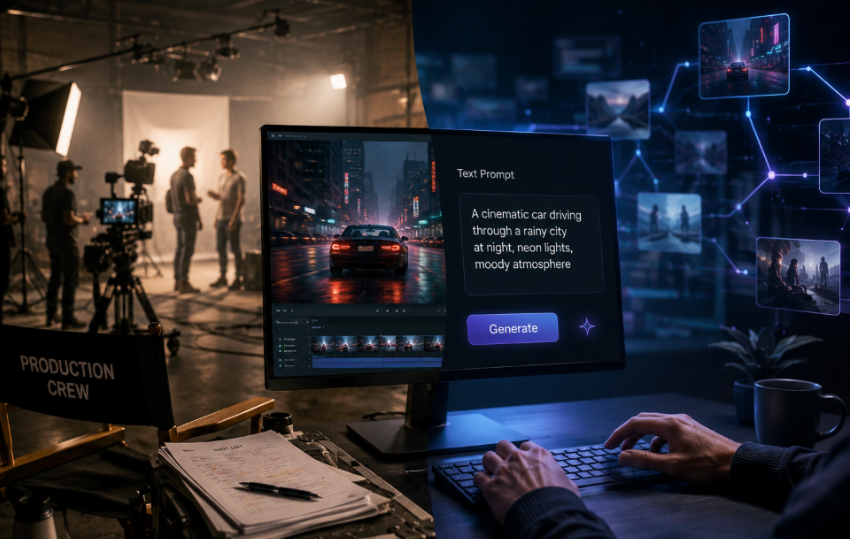
A year ago, a 60-second commercial meant a treatment deck, a casting call, a location scout, a shoot day, and a six-figure invoice. In 2026, some brands are getting a finished spot from a text prompt before lunch. The question dividing marketing departments and agency boardrooms alike isn’t whether generative video tools like Sora, Veo, and Meta’s in-house ad AI can make a commercial — they clearly can — it’s whether brands should let them replace the humans who used to make one.
The Pitch: Prompts Instead of Production Crews
The economics are the loudest argument for going AI-first. Industry benchmarking shows generative video tools can cut per-video production costs by 70% to 90%, with one widely cited breakdown showing costs falling from roughly $4,500 a minute of traditional footage to around $400 a minute with AI generation. Turnaround has compressed just as dramatically: a 60-second marketing video that once took about 13 days from brief to final cut can now move through the same pipeline in roughly 27 minutes, and companies using AI video report about 68% faster time-to-publish overall.
Adoption is following the math. Nearly 90% of advertisers say they’re already using, or actively planning to adopt, generative AI to build video ad creative, and buyers now expect AI-generated material to make up close to 40% of all video ads by the end of 2026. Smaller and mid-size brands are moving fastest — SMBs expect AI to produce 45% of their digital video output this year, compared with 36% among the largest advertisers, who have more budget, more legal exposure, and more to lose from a misfire.
That gap matters. It suggests this isn’t really “AI vs. Hollywood.” It’s AI unlocking a volume and speed of ad-making that was never affordable for the mid-market and long tail of brands who couldn’t hire a studio in the first place — while giant advertisers experiment more cautiously, in public, with much higher stakes.
The Case Studies: From Super Bowl Spotlight to Quiet Backlash
The clearest 2026 showcase came at Super Bowl LX in February, where AI moved from novelty to centerpiece. Vodka brand Svedka ran what it billed as the first primarily AI-generated national Super Bowl commercial, “Shake Your Bots Off,” built around dancing robot characters Fembot and Brobot. Working with AI production partner Silverside, the team spent roughly four months rebuilding Fembot and training the model to replicate facial expressions and body movement — notably, the storyline itself was still written by humans, underscoring that “AI-generated” in practice usually means AI-assisted. Elsewhere in the same ad break, Anthropic, Amazon (with Chris Hemsworth), Meta, Google, and OpenAI all ran AI-themed or AI-produced spots, prompting commentary that the game had turned into an AI showcase — and, per one widely shared take, proof that algorithms still can’t replace creative directors.
Coca-Cola has been the most persistent test case. Its AI-generated riff on the classic “Holidays Are Coming” campaign drew heavy backlash in 2025 over uncanny trucks and generic-feeling crowds, with critics calling it “AI slop.” Rather than retreat, Coca-Cola doubled down for its 2025-into-2026 holiday push, with the campaign’s co-creator publicly defending the work — a signal that brands are increasingly willing to absorb reputational heat in exchange for speed and novelty, treating backlash almost as a cost of doing business rather than a stop sign.
McDonald’s tested that tolerance and found its limit. Its AI-generated Christmas commercial, “It’s the Most Terrible Time of the Year,” was pulled within days of release after being branded “offensive from every angle” on social media. Unlike Coca-Cola, McDonald’s didn’t defend the spot — it disappeared quietly, illustrating that not every brand has the risk appetite, or the built-in irony, to weather an AI misfire.
What This Is Doing to the Agency Business
The production-studio squeeze is showing up in holding-company numbers, not just anecdotes. WPP, the world’s largest ad holding group, is cutting several hundred jobs globally by the end of 2026 and has folded its production capabilities into a single new “WPP Production” unit — a consolidation widely read as a response to AI compressing the volume of billable production work. Omnicom’s recent reporting has been read by analysts at eMarketer as signaling a broader shift of agency investment from human talent toward AI tooling.
The job impact isn’t evenly distributed. It’s landing hardest on the production layer — junior editors, motion designers, on-set crew, and the vendors who used to handle short-form and paid social variants — while strategy, brand-safety review, and creative direction roles are, so far, proving stickier. Agencies that survive this cycle are repositioning as AI orchestrators: fewer people running cameras, more people prompting, curating, and fixing what the model gets wrong, then applying the legal and brand-safety scrutiny that generative tools still can’t do on their own.
Where Humans Still Win
The McDonald’s pull and the persistent “AI slop” criticism aimed even at Coca-Cola point to a real ceiling. Generative video still struggles with consistent character continuity, culturally specific nuance, and the kind of subtle brand tone that a human creative director catches instinctively and a model doesn’t. Big, reputation-sensitive campaigns — the ones with the most to lose — are the ones still leaning on human production, or at minimum human-led AI supervision, exactly where the adoption data shows the largest brands moving slowest.
The Takeaway
Brands aren’t uniformly ditching production studios for prompts — they’re triaging. Low-stakes, high-volume, performance-driven ad creative is migrating to AI fast, chasing that 70-90% cost reduction and near-instant turnaround. High-stakes brand campaigns are still routed through humans, or through hybrid teams where AI drafts and people fix, approve, and take the blame if it goes wrong. The agencies losing the most ground are the ones still selling pure production; the ones adapting are selling judgment.
Sources
- AI Video Ad Statistics 2026: 45+ Sourced Stats — Adwave
- From Svedka to Anthropic, brands make bold plays with AI in Super Bowl ads — TechCrunch
- Silicon Valley’s Super Bowl Fumble: Why AI-Generated Ads in 2026 Proved Algorithms Still Can’t Replace Creative Directors — WebProNews
- Coke AI Ad Tests Consumers’ Trust In New Advertising Era — Forbes
- Coca-Cola Doubles Down on AI Commercial Following Last Year’s Backlash — AOL
- Holiday Hype or Digital Slop? Coca-Cola’s 2025 AI Ad Sparks Industry Split — Hyperight
- Why McDonald’s Pulled This AI Christmas Ad After an AI Slop Backlash — WinBuzzer
- McDonald’s pulled AI ad offers lessons on what audiences will and won’t accept — eMarketer
- WPP set to trim several hundred jobs globally by end of 2026 — Adgully
- WPP rolls production capabilities into new WPP Production unit — Yahoo Finance
- Omnicom’s latest report signals an agency shift from human talent to AI — eMarketer