
 by
by The moment a sketch on paper transforms into a concept that shapes how millions think—that’s where science, psychology, and design meet. A simple branching diagram. A few overlapping circles. A hand-drawn symbol. These aren’t just pictures; they’re vessels that carry and transmit ideas with a force that words alone cannot match. But when exactly does a visual stop being mere illustration and become an idea itself?
- The Brain’s Visual Shortcut
Before we can understand when a visual becomes an idea, we need to understand how quickly visuals move through our minds. The brain processes visuals 60,000 times faster than text, a neurological advantage built into our evolutionary history. More than 50% of the cortex is dedicated to visual processing, making it our dominant sensory channel.
But speed alone doesn’t transform a visual into an idea. The real magic happens through what cognitive scientists call dual coding. The brain utilizes two interconnected systems for processing information: verbal and visual. Combining words with images enhances memory retention and comprehension. When we see a visual representation of an abstract concept, our brain doesn’t just register the image—it creates a bridge between what we see and what we think, turning the ephemeral into the concrete.
Visual-spatial processing is a fundamental component of cognitive functioning that influences the formation of remote associations, fostering creative thinking and the generation of innovative ideas. In other words, seeing something doesn’t just inform us; it enables us to think in new ways.
- The Three Stages: From Concrete to Abstract
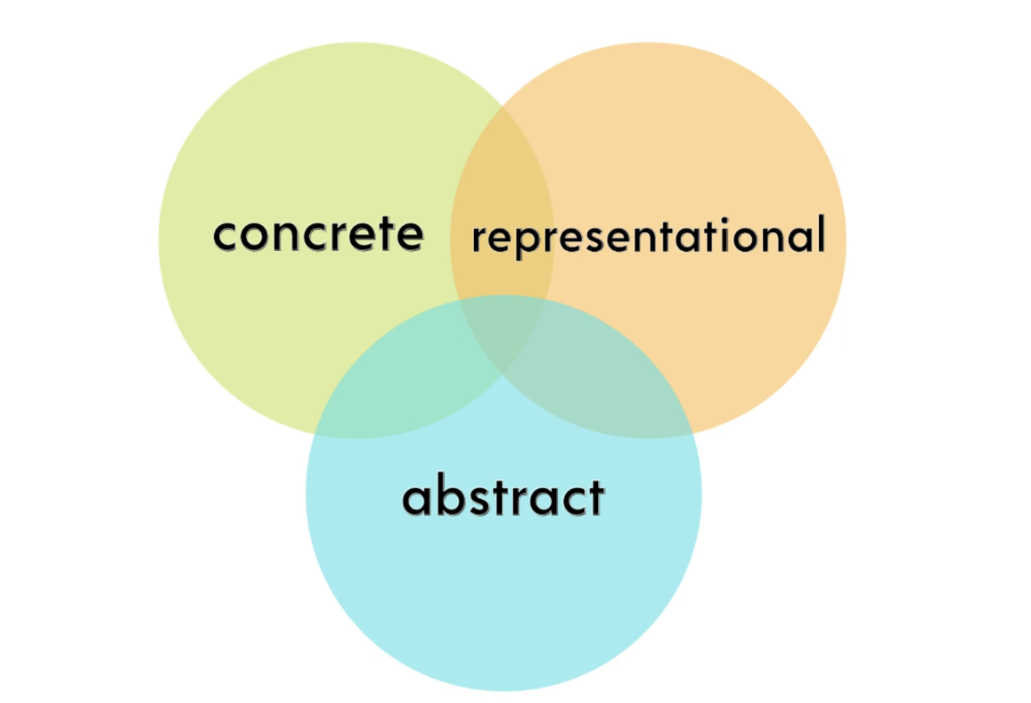
One of the most useful models for understanding this transformation is the CRA approach-Concrete, Representational, Abstract. Developed from Jerome Bruner’s theory of cognitive development, it reveals how humans gradually build ideas from what they observe.
Typically, a child will start by experiencing a new concept in a concrete, action-based form. They move to making a representation of the idea, in pictures or more sophisticated diagrams, and then to using abstract, symbolic notation. This progression isn’t unique to children learning math; it mirrors how cultures, science, and entire fields of thought have advanced.
For concrete concepts, visual representations can directly resemble their physical appearance, whereas abstract concepts require alternative strategies for visual representation. This is the crucial transition: when a visual becomes abstract enough to stand for something beyond itself, it becomes an idea. A stick figure isn’t just a drawing of a person—it’s a symbol for humanity. A triangle isn’t just a shape—it can represent stability, progress, or a hierarchy.
- Darwin’s Tree: When One Diagram Changed Everything
Perhaps no single visual has better illustrated this transformation than Charles Darwin’s “Tree of Life.” Drawn around July 1837, after his return from his voyages on HMS Beagle, it’s seen as the first iteration of him visualizing a theory of evolution by descent from a common ancestor. The diagram was simple—lines branching from a trunk—yet it contained within it an entirely new way of thinking about life itself.
The idea of a tree as a metaphor for understanding and graphically displaying relationships among organisms is most often attributed to Charles Darwin, who fully developed the notion in his 1859 Origins of Species. But what’s remarkable is that Darwin wasn’t just illustrating an idea he’d already fully formed in words. The diagram itself was generative. By attempting to draw evolutionary relationships, Darwin clarified and deepened his own thinking.
To many, evolutionary trees are the embodiment of the theory, of the historical narrative of life. They summarize evolution: Darwin’s principle of the non-fixity of species, common descent, and diversification by a branching process from ancestral forms to modern ones. Thus, trees are the icons of evolution. Today, it’s nearly impossible to think about evolution without picturing a tree. The visual and the idea have become inseparable.
- Symbols as Ideas Crystallized
The transformation accelerates when a visual becomes so efficient, so resonant, that it functions as pure idea. Consider the Venn diagram—three overlapping circles that seem almost absurdly simple, yet they encode an entire logical system.
Venn diagrams use spatial and geometric arrangements to illustrate conceptual relationships. For example, you might see that knowledge exists where the circles for “justified” belief, “true” belief, and “belief” all overlap. The moment you see those circles overlap, understanding arrives—not through explanation, but through the form itself.
Iconic logic uses icons that resemble what they stand for and whose meanings are thus easier to picture, process, and remember. Icons like the power symbol (1 and 0 superimposed) or the play button work because their form carries meaning without requiring translation. The visual is the idea.
Company logos like Apple or Nike work as powerful modern symbols. A well-made logo can quickly show a brand’s values and earn trust. A bitten apple isn’t just an image; it’s a constellation of meanings—innovation, simplicity, rebellion—all compressed into visual form.
- Abstraction: The Bridge Between Seeing and Thinking
The real turning point—when a visual definitively becomes an idea—happens at the moment of abstraction. Visual representations simplify the complex, converting the abstract into concrete, making the inscrutable suddenly crystal clear. They serve as translators, decoding abstract concepts into a language we can understand.
Consider how we teach mathematics. A student struggling with the concept of fractions can’t grasp it through words alone. But draw a circle divided into quarters, shade in one, and suddenly the abstraction becomes visible. The visual representation isn’t replacing the idea; it’s embodying it. At that moment, the drawing and the concept fuse.
The link between visual representation and conceptual connections can be observed in Chinese characters, more specifically in those categorized as Ideogrammic Compounds. These characters can be decomposed into others whose concepts are semantically related, belonging to the same conceptual space. Each character is both a visual form and a carrier of meaning—there is no separation.
- The Design of Understanding
In contemporary design and innovation, this principle has become foundational. When designers create visualizations, they’re not simply making information pretty; they’re reshaping how people think.
Graphic facilitators use visual thinking to turn abstract ideas into clear, engaging visuals. Whether it’s a flowchart, mind map, or sketchnote, these tools help participants ‘see’ the big picture and think more creatively. The act of visualizing forces a kind of clarity that pure verbal discussion rarely achieves. Ideas crystallize in the act of drawing them.
From allegorical frescoes of the Renaissance to conceptual installations of the twenty-first century, artists have continually turned to philosophical ideas to inform and challenge their practice. Art gives philosophical concepts tangible form, engaging viewers on emotional and sensory levels. When philosophy becomes art—or data becomes visualization—the abstract becomes accessible.
- The Threshold
So when does a visual become an idea? It’s not a single moment but a threshold crossed when several conditions align: when the visual is simple enough to grasp immediately, abstract enough to transcend its literal form, and resonant enough to reshape how we think.
A sketch remains a sketch until it captures something essential. Then it becomes a symbol. Then it becomes a tool for thought. Finally, it becomes inseparable from the idea itself. Darwin’s branching lines are no longer an illustration of evolution—they are evolution, at least in how we conceive of it.
The next time you see a diagram that suddenly makes something click, or an icon that instantly communicates a complex idea, pause and notice: you’re witnessing a visual that has transcended its own form to become an idea that shapes minds.