

 by
by Meet Your New Actress. She’ll Be Someone Different Next Scene.
Picture this: you’ve just generated the perfect AI video clip. Your protagonist has flowing auburn hair, sharp green eyes, and a teal trench coat. It’s cinematic. It’s beautiful. It’s exactly what you imagined.
Then you generate the next shot.
Suddenly her hair is a shade darker. The coat has vanished. Her eyes seem subtly different. Is that even the same person? Welcome to the single most frustrating, most talked-about problem in AI video generation today: consistency.
The “Groundhog Day” Problem
Every frame an AI video model generates is, in a sense, starting from scratch. Unlike a human animator who remembers what a character looked like in the last frame, most generative video systems predict pixels based on probability — not a persistent memory of “this specific character.”
It’s a bit like asking a sketch artist with amnesia to redraw the same person over and over from a blurry description. Sometimes they nail it. Often, they don’t.
Even traditional, human-made film isn’t fully immune to this. Continuity has always been hard — which is exactly why professional productions hire a script supervisor whose entire job is tracking every prop, hairstyle, and camera angle between takes:
Real film sets get caught out too. Here’s a well-documented continuity slip from a beloved TV drama — full crew, full script supervision, and a hand position still flips between two adjacent shots:
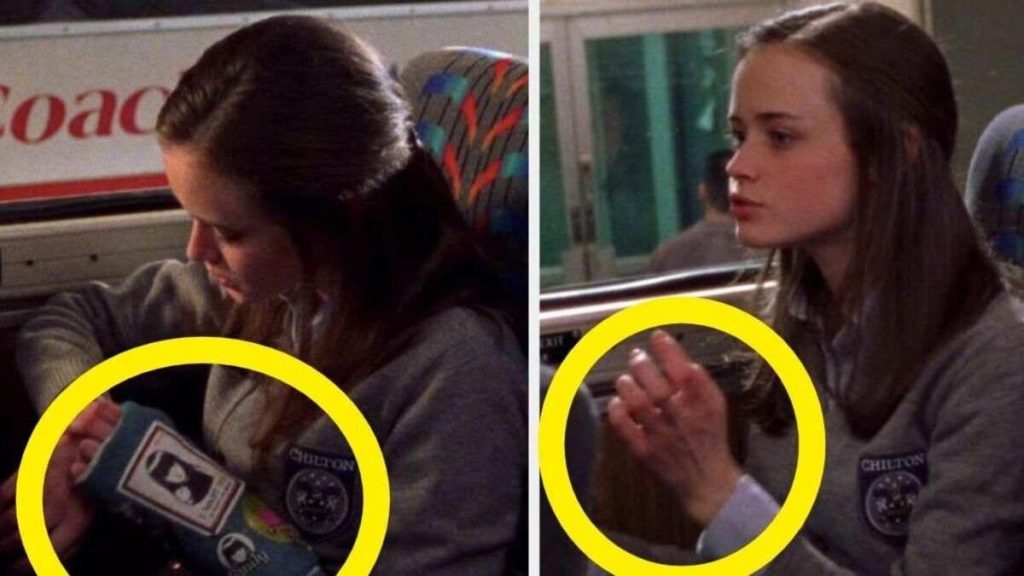
If human film crews with dedicated continuity departments still slip up occasionally, it’s no surprise that AI models — with zero persistent memory of the world they’re building — struggle far more.
Two Flavors of Drift
- Character Drift — the same “character” morphs subtly (or wildly) between shots: different face shape, wardrobe, hair color, even apparent age.
- Scene Drift — environments shift too. A coffee shop with a red awning in shot one becomes a blue awning by shot three. Lighting flips direction. Objects rearrange themselves like a poltergeist is redecorating.
Why Is This So Hard to Fix?
It comes down to how these models actually work. Most text-to-video and image-to-video systems are diffusion-based — they generate content by starting with noise and gradually “denoising” it into a coherent image or clip, guided by a prompt. Each generation run is largely a fresh roll of the dice unless deliberately anchored.
A few technical reasons this is such a hornet’s nest:
- No persistent 3D world model — the AI isn’t building a virtual set with characters standing in it; it’s predicting plausible pixels frame by frame, fundamentally different from how a game engine or animation rig works.
- Prompts are lossy — describing “a woman, mid-30s, auburn bob haircut, teal trench coat” in text can’t capture the same fidelity as an actual reference image, so small details get reinterpreted every time.
- Longer videos compound the error — even models that hold consistency well for four or five seconds start drifting as clips extend, because small frame-to-frame errors accumulate like a game of telephone.
- Multi-shot editing has no continuity memory — cut from a wide shot to a close-up, and the model has to reconstruct the character almost from scratch, with nothing forcing agreement with the previous shot.
“Consistent AI Characters: Solved?” is one of the most-clicked headlines in the AI creator community right now — and for good reason.
How the Industry Is Fighting Back
This isn’t a hopeless problem — it’s the hot problem, the one every major AI video lab and toolmaker is racing to solve, because it’s the difference between “cool tech demo” and “actually usable for storytelling.”
1. Reference-Image Conditioning
Instead of describing a character purely in text, creators feed the model an actual image (or several) of the character from different angles, giving it a visual anchor to stay faithful to — much like an art department’s character turnaround sheet.
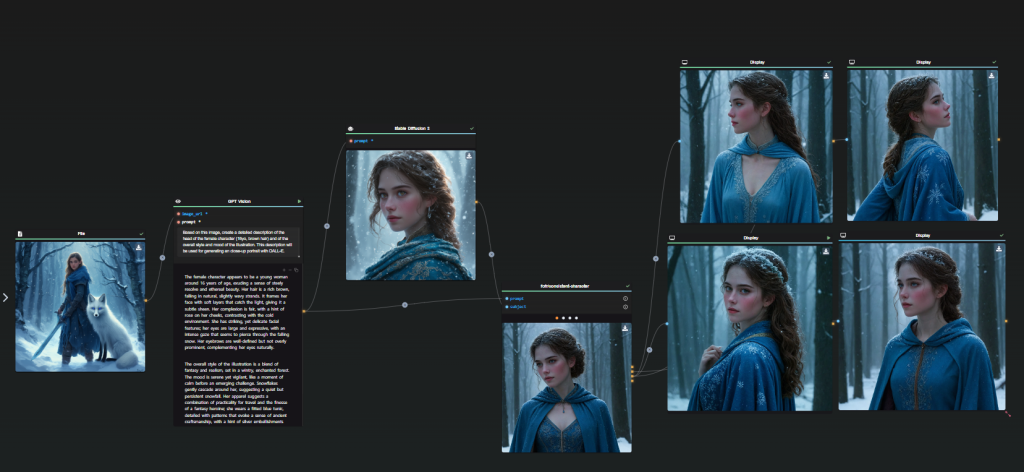
Some pipelines take this further, using vision models to describe a reference image in exhaustive detail and then feeding that description back into the generator — an automated relay between “looking” and “drawing”:
2. Character Fine-Tuning and Model Adapters
Training small, lightweight adapters (often called LoRAs) on a specific character’s likeness lets a model “know” them across generations — similar to how custom checkpoints work for still-image diffusion models. Feed it enough clean reference angles, and the character’s identity becomes baked into the weights rather than re-guessed every time.
3. Storyboard-First Pipelines
A growing category of tools now generates an entire storyboard — consistent characters and settings across dozens of panels — before a single frame of video is rendered, catching drift at the planning stage rather than fixing it in post.
4. Seed Locking, First/Last-Frame Anchoring, and 3D-Aware Models
Reusing the same noise seed or latent representation across generations keeps the underlying “DNA” of a scene stable, while first-frame or last-frame anchoring stitches new clips onto exactly where the previous one ended — like a relay race instead of independent sprints. Meanwhile, newer research is exploring implicit 3D-awareness and object permanence, so a coffee cup doesn’t just vanish because the camera panned away and back.
Why This Actually Matters
It’s easy to dismiss this as a technical curiosity, but consistency is the entire foundation of storytelling. Audiences build trust in a narrative through stable details — a scar that stays on the same cheek, a jacket color that doesn’t flicker, a room layout that makes sense. Break that trust, even subtly, and viewers feel it, even if they can’t articulate why.
This is why so many current AI-generated shorts feel uncanny or dreamlike rather than grounded — our brains are cataloguing every inconsistency as “something is wrong here,” even in fleeting glances.
Solving character and scene consistency isn’t just a nice-to-have feature. It’s the bridge between AI video as a novelty generator and AI video as a genuine filmmaking tool — the difference between a slot machine of pretty clips and an actual director’s paintbrush.
The Road Ahead
The pace of progress here has been startling. Tools now exist that let creators lock a character’s face across dozens of shots, maintain consistent environments through multiple angles, and even manage lighting continuity — problems that felt unsolvable eighteen months ago. But full, studio-level consistency across a multi-scene, multi-character story, with the reliability a professional production needs, is still the frontier.
Whoever cracks this most elegantly won’t just win a technical benchmark. They’ll unlock AI video’s biggest promise: not just generating clips, but genuinely telling stories.