

 by
by We are living in a time where almost everything feels powered by AI.
Every conversation, every new tool, every workflow somehow circles back to it. It is fast, accessible, and evolving at a pace that is hard to keep up with.
AI is no longer something experimental. It is actively being used in real projects.
AI isn’t just a buzzword; it’s a fundamental shift in how we used to work and how we work now. We’ve entered an era where the traditional handshake between a human designer and AI tools.
But if you are working in motion graphics, animation, or video production, AI is not just another tool in the stack.
It is changing how we think.
It is changing how we create.
And more importantly, it is changing how we define “production.”
At the same time, there is a dangerous misunderstanding growing that AI alone is responsible for the output. That if you give the right prompt, the system will handle everything else.
It is the combination of human thinking and AI execution that is actually making things work. It is the combination of human thinking and AI execution.
This is what I like to call the AI + Human handshake.
This blog is not theory. It is based on how we used AI tools in real projects to create quick-commerce advertising videos, what worked, what failed, and how this approach compares to traditional production.
Instamart Holi.mp4 Instamart Pichkari.mp4
The Gold Standard: Why Real Sets Still Matter
Before diving into AI workflows, it is important to acknowledge something clearly.
High-end physical production is still the gold standard.
If a brand has the budget, the time, and the need for cinematic storytelling at scale, nothing replaces a real set. Real lighting behaves differently. Real materials interact with light in ways AI still struggles to replicate. This is the reason why large-scale campaigns still rely on physical shoots.
But here is the shift. Not every campaign needs that level of production. And more importantly, not every campaign can afford it.
Quick-commerce operates in a completely different environment. Trends change fast. Timelines are compressed. The expectation is not just quality, it is speed.
You are not building a film. You are building communication that needs to go live now. This is where traditional production starts to break. And this is exactly where AI becomes useful.
Not as a replacement for real sets but as a strategic alternative for speed-driven content ecosystems.
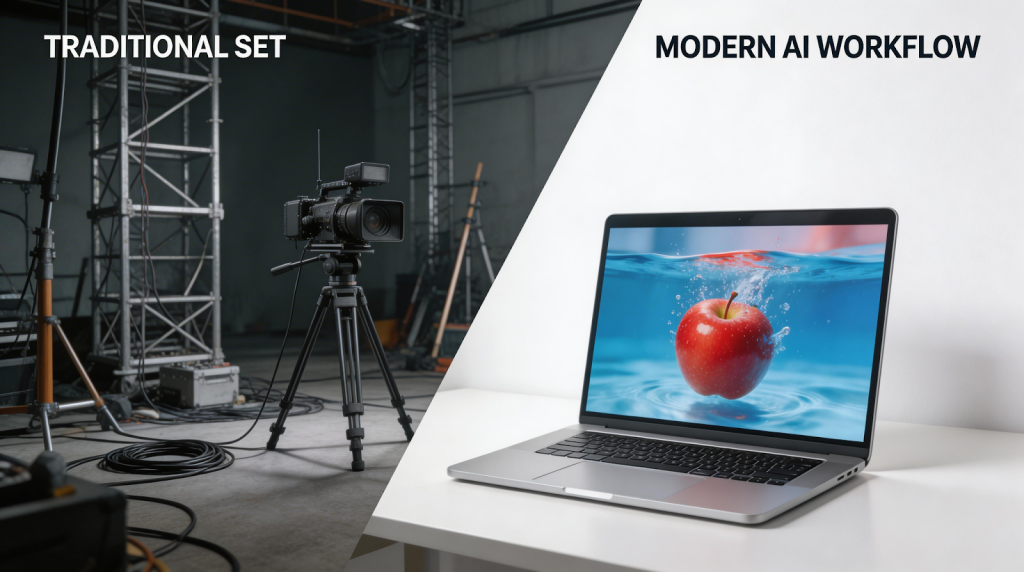
The Traditional Road vs. The AI Highway
The Traditional Road:
Let’s break this down without romanticizing it. A traditional video production pipeline looks something like this:
Pre-production: Storyboards, planning, approvals
Production: Crew, equipment, lighting, talent, locations
Post-production: Editing, VFX, grading, sound
All of this works perfectly if you have time.
But quick-commerce doesn’t operate on that timeline.
When a brand needs to respond to a festival, a trending product, or a competitor move, waiting three weeks for a 15-second video is not practical.
Even worse, the cost structure does not align with the frequency of content needed.
You are not producing one hero film.
You are producing multiple assets, repeatedly, across categories.
This is where things start to slow down.
And in a fast-moving market, slow work is not just expensive
it puts you behind your competitors.
The AI Shift:
AI did not enter this space as a creative revolution.
It entered as a production solution.
The real value of AI is not that it “creates videos.”
This is where most people get it wrong.
They assume AI reduces effort.
In reality, it redistributes effort.
The work does not disappear.
It moves.
- From managing shoots -→ managing systems
- From directing people – directing outputs
- From logistics – control
And this is where the real skill gap begins.
Why “Prompting” Is Not the Real Skill?
There is a popular misconception that AI video creation is about writing prompts.
It is not.
In reality, it is about designing shots that the model can survive. As a motion graphics designer, my job has shifted from just “creating” to “directing” the AI.
We call this “Shot Thinking.” Instead of asking the AI to “make a video, we break the scene into shots, By breaking a 10 to 15-second ad into these smaller units.
Each shot has:
- A clear purpose
- A clear composition
- A clear role in the story
Example:
By doing this, you are not asking AI to “figure out the story.”
You are defining it.
Because AI does not understand intention. It responds to structure.
The Reality of AI Output: Control vs Chaos
Here is something most people don’t talk about enough.
AI is unstable by default.
If left uncontrolled:
- Faces change
- Objects morph
- Lighting shifts
- Continuity breaks
And not adding more words doesn’t fix it.
More words ≠ more control
In fact, over-describing often makes things worse.
What works better is:
Constraint-led prompting
Instead of describing everything, we define boundaries.
We control what must remain stable.
Three Pillars of Stability
1. Locked Identity
The character must remain visually consistent across shots.
2. Physical Realism
Objects must react with weight and pressure during interaction.
3. Continuity Sense
Lighting, environment, and tone must stay consistent.
These are not enhancements.
They are requirements.
Without them, the output breaks.
Three Pillars of Stability.mp4
Where Human Thinking Becomes Non-Negotiable
This is where the “AI replaces creatives” narrative collapses.
Because none of the critical decisions come from AI.
AI does not:
- Decide framing
- Understand pacing
- Define emotional tone
- Judge quality
Humans do.
This is the real handshake:
AI executes.
Humans decide.
The output quality depends entirely on input clarity.
Weak thinking → Weak output
Clear thinking → Strong output
What This Means for Quick-Commerce Brands
This is not just a creative shift.
It is a business decision.
When used correctly, AI production delivers:
1. Cost Efficiency
Reduced dependency on physical production
2. Speed to Market
Concept to execution in days, not weeks
3. Control & Iteration
Test, refine, and adapt quickly
But there is a catch.
AI only works if you understand it.
The Future: Not AI vs Humans, But AI With Humans
This is not a replacement story.
This is a role shift.
- Execution → faster
- Iteration → cheaper
- Thinking → more valuable
The winners won’t be the ones who use AI the most.
They’ll be the ones who direct it best.
And who know:
- When to use AI
- When not to use AI
The Final Take: AI + Human
AI is powerful. But without direction, it is just output without meaning.
The real shift is thinking.
- From execution → decision-making
- From doing → directing
The idea, the story, the emotional core
That still comes from humans.
AI accelerates execution.
It is the engine.
But direction, control, and purpose still belong to the human behind the wheel.
And as long as that remains true
This is not the end of creativity. It is an upgrade.
Conclusion
Will AI eventually be able to do all of this perfectly?
At the end of the day, it is important to remember that AI is a technology, not a creative platform. It doesn’t have a “vision” or a “heart” it has “algorithms”.
Using AI tools doesn’t replace the need for a creative brain; instead, it challenges us to be smarter and faster, helping us learn new workflows, test ideas in seconds, and execute complex videos.
But the creativity, the decision of what the story is, why it matters, and how it should feel will always belong to us.
Will AI eventually be able to do all of this perfectly? Probably. But for now, humans are still the ones behind the wheel. The creative works, the spark comes from us. AI is just the powerful engine that helps us get there faster. Without the human brain to guide it, AI is just tech. With the human handshake, it’s a revolution in storytelling.