 by
by A very honest conversation for creators who want to stay relevant in 2026
From a copy-led thought to a story-led visual:
How one woman writes the story, another designs the feeling, and AI helps us bring it to life (without ruining it).
1: Before We Talk About AI, Let’s Talk About Us
Let’s start with a simple question.
What’s your relationship with AI today?
Is it exciting?
Is it intimidating?
Or is it that thing you secretly use but don’t fully trust yet?
If you’ve had even one late-night creative spiral thinking “Will AI replace me?” you’re not alone. We’ve had that conversation with a lot of creators recently.
Copywriters. Designers. Filmmakers. Strategists.
And the answer is rarely black or white.
Some days AI feels powerful.
Some days it feels threatening.
Most days, it feels like… both.
But here’s the part most conversations miss:
AI isn’t deciding the future of creativity. Storytelling is.
Storytelling Was Getting Diluted Long Before AI Showed Up
Everyone is a writer today. AI tools can generate captions, blogs, scripts, even full-fledged campaigns in seconds.
According to industry surveys, more than 80% of creators are already incorporating AI tools into workflows like content drafting, ideation, and editing.
But something important has quietly taken a hit.
Intent.
Not because AI exists. But because shortcuts have become acceptable.
Hooks replaced context. Speed replaced thought.
And storytelling slowly became something we optimized instead of something we crafted.
AI didn’t break storytelling.
It just exposed how often we were skipping the hard part.
Thinking.
2: How a Copywriter Thinks (Hint: It’s Not in Prompts)
Let me tell you how a copywriter actually starts writing.
Not with: “What should I say?”
But with: “What is changing for the person reading this?”
Before a single word lands on the page, there’s an internal process, almost instinctive:
Where is the tension? Who feels it? What’s at stake here?
This is the difference between thinking in stories and thinking in prompts.
I’ll tell you.
If you’re good at prompting (even okayish), you already know this:
Prompts describe outputs.
Do you know what stories do?
Stories describe emotions in motion.
When a creator jumps straight into AI-generated language without answering the emotional questions first, the result sounds polished, but rarely lands.
It feels familiar. Predictable.
And honestly? Forgettable.
Do you remember every ad you see? (No, right?)
Because AI is brilliant at pattern-based generation.
But it does not understand emotional nuance or intent on its own.
That part is still painfully, beautifully human.
The Don’ts (Yes, We’re Saying This Out Loud)
Let’s make this clear.
Here’s what we will never use AI for:
- Generating scripts without a story first
- Writing dialogue without knowing who the person is
- Designing visuals without deciding how the audience should feel
- Letting AI decide what matters in a story
Because once AI starts making creative decisions instead of supporting them, the work starts to flatten.
How We Actually Use AI (The Right Way)
Here’s what does work:
- Have a story before you prompt
- Feed AI the emotional angle, not just the task
- Let AI help with research, structure, and exploration
- Let it refine, not originate the idea
AI can accelerate thinking. It cannot replace judgement.
Great copy doesn’t chase attention. It respects the reader enough to earn it.
An Example (Yes, It’s About Chocolate)
Let’s keep this simple.
A chocolate bar.
Made specifically for late-night cravings.
Prompt-first approach:
“Write a tagline for a chocolate bar for night-time snacking.”
The result?
Polished, but something you will forget next minute
(Meh, as Gen-Z would say.)
Story-first approach:
It’s 11:47 PM.
She’s had the worst day.
She’s not hungry, she just needs comfort.
This isn’t about hunger.
It’s about a small, private reward after surviving the day.
That is the story. Now feed that to AI.
The output changes instantly.
Because the copywriter understood the emotion before the ad was written.
That’s the difference.
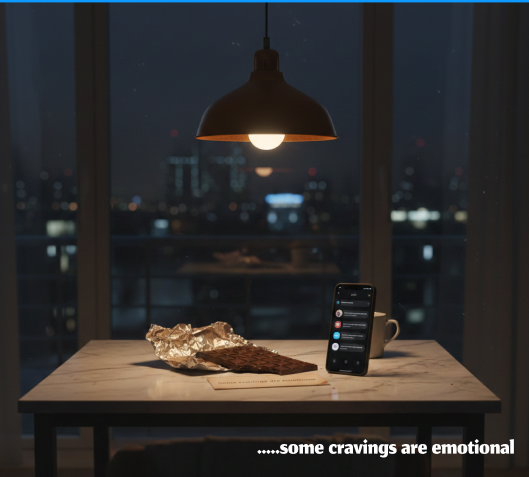
Ad created with a story
3: When a Story Becomes Visual (And Why Designers Hate Random Prompts)
Here’s where the woman-of-art steps in.
A story doesn’t become visual the moment you open an AI image tool.
It becomes visual the moment you decide what the audience should feel.
That question always comes first.
Before style.
Before colour.
Before camera angles.
Every strong visual narrative is built on emotional beats, not assets.
A pause.
A reveal.
A shift.
A moment of relief, tension, or comfort.
AI can be incredibly powerful here—but only as a thinking partner.
Once intent is clear, AI lets us explore:
Literal vs metaphorical, Intimate vs expansive, Stillness vs motion
But direction?
That still has to come from us.
When visuals feel generic, it’s rarely because AI failed.
It’s because the ask lacked emotional intent.
H3: The Clevertize Way (Where Copy Meets Art)
At Clevertize, this is where copy and design truly meet.
Every script starts with a 3-grid framework:
VO (Voice Over)
Where the story lives. Emotion, pacing, narrative tension.
Supers
What text appears on screen and why.
Visuals
Mood. Lighting. Camera. Movement. Scale. Feeling.
One rule guides everything:
Every frame must make the audience feel something.
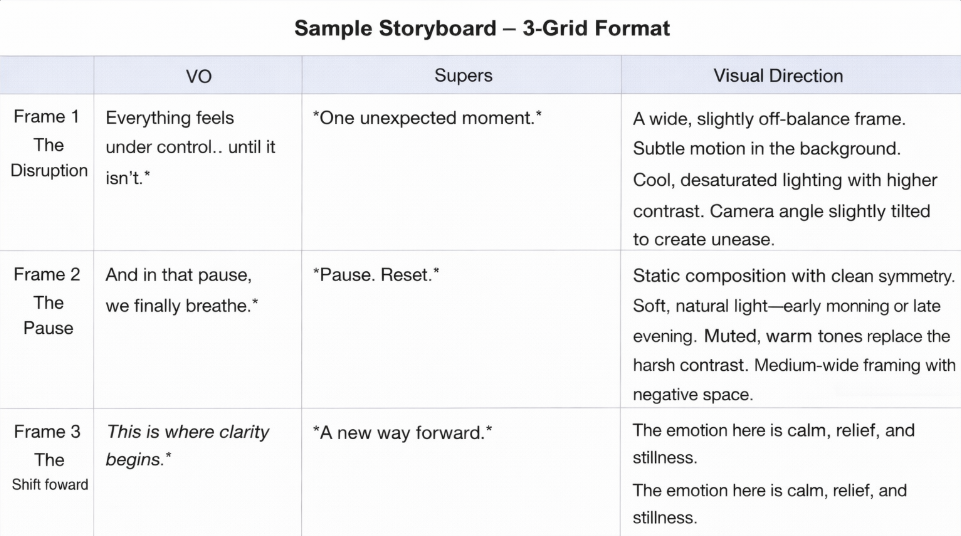
3-grid format for storyboard
This is how AI becomes a collaborator.
Not a shortcut.
4: Designing Storyboards With AI (Not Screens)
A storyboard is not a collection of layouts.
It’s a sequence of emotional decisions.
Stories unfold.
They breathe.
They pause.
Each frame exists for a reason.
Each transition carries weight.
AI works beautifully here, if used intentionally.
It can help us:
- Explore pacing
- Test shifts in energy
- Visualize motion, not just frames
More options don’t mean better storytelling.
Clarity comes from choosing, and standing by it.
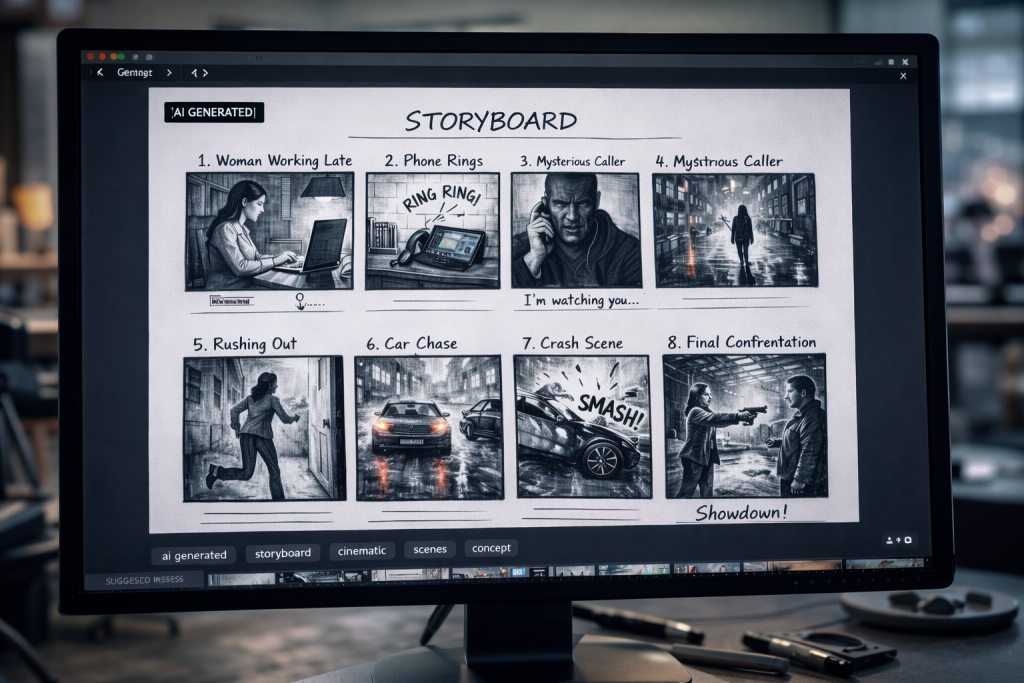
AI-developed storyboard
5: Where AI Adds Value and Where It Must Stop
AI is at its best when it removes friction, not responsibility.
It accelerates exploration.
Sharpens structure.
Expands possibilities.
But it does not understand:
Which silence should linger?
Which emotion needs restraint?
Which moment deserves space?
AI understands patterns. Not meaning.
And the moment you outsource meaning, the story becomes generic, no matter how polished it looks.
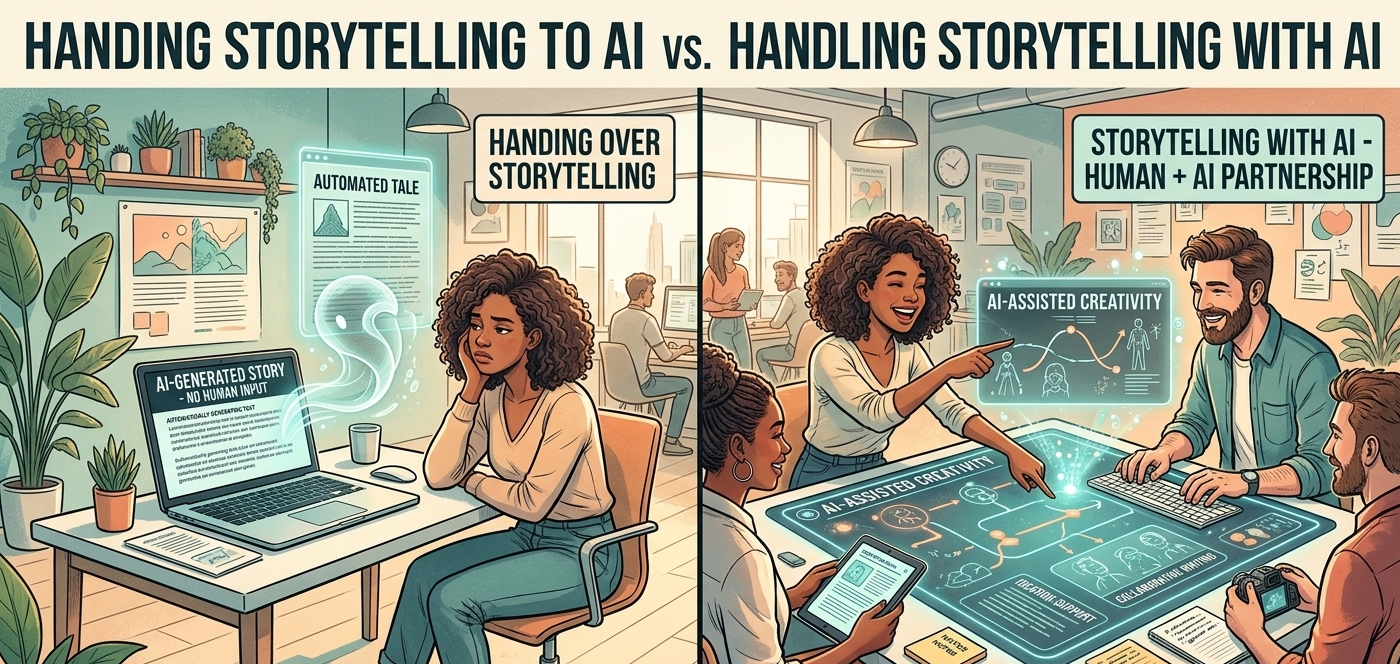
The future of storytelling isn’t human or AI.
It’s knowing exactly where each belongs.
From Two Women Who Build Stories Every Day
One of us writes the story.
One of us designs how it feels.
And both of us use AI, not to replace thinking, but to see our ideas more clearly.
So let the human imagine the story.
Let her decide how it should be felt.
And let AI help bring that vision to life.
For creators in 2026, this balance isn’t optional.
It’s the difference between producing more content
and creating stories that actually stay with people.