 by
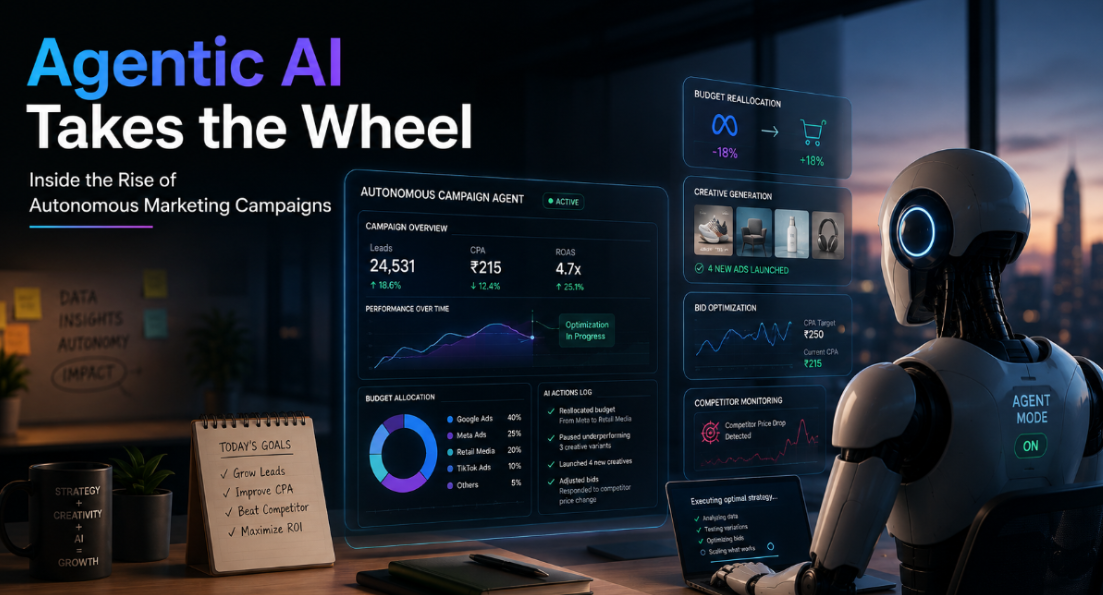
by A marketing team logs in on Monday morning and finds that over the weekend, an AI agent quietly reallocated ad budget across five channels, killed three underperforming creative variants, wrote and launched four new ones, and adjusted bids in response to a competitor’s price change — all without a single human approval click. This isn’t a hypothetical. It’s the operating reality inside a growing number of marketing orgs in 2026. Gartner expects task-specific AI agents to be built into 40% of enterprise applications by the end of this year, up from under 5% in 2025. The question marketers are wrestling with isn’t whether to hand agents the wheel, but how much steering room to leave them.
What “Agentic” Actually Means
Marketing automation has existed for two decades: trigger-based email sequences, rule-based bid adjustments, if-this-then-that workflows. It executes instructions a human wrote in advance.
Agentic AI is different in kind, not just degree. An agent perceives a goal (“grow qualified leads at a target CPA”), breaks it into sub-tasks, chooses which tools or channels to use, takes action, evaluates the outcome, and adjusts — in a loop, without a human re-writing the rules each time. Industry researchers at Netcore and Taboola frame the distinction as automation following a script versus agents pursuing an objective and deciding the script themselves.
In practice that means an agent might independently decide to shift budget from Meta to a retail media network mid-flight because it’s seeing better return there, something a static automation rule was never built to do.
The Platforms Driving It
The shift is visible in what the largest ad and martech platforms shipped this year. Google’s AI Max upgrade folded Dynamic Search Ads and broad-match-style discovery into Performance Max, letting the system autonomously expand targeting and generate assets with less manual campaign structure. Meta has pushed Advantage+ further into full-funnel autonomy, with AI agents inside Ads Manager increasingly handling budget pacing, placement, and creative testing with minimal manager input, though independent reviewers note the “black box” nature of these decisions remains a real point of friction for advertisers.
Salesforce’s Marketing Cloud Next, part of its broader Agentforce push, markets its agents as “always-on brand ambassadors” that draft campaign briefs, recommend audiences, build customer journeys, and flag underperforming ads with budget-reallocation recommendations — largely from a natural-language prompt. Standalone players like Albert.ai have offered autonomous, cross-channel campaign management (spanning Google, Meta, TikTok, and programmatic buys like DV360) for longer than the current hype cycle, positioning itself as running “planning, setup, optimization, reporting” as one continuous loop rather than a set of separate human-triggered tasks.
The agency holding companies are racing to build their own orchestration layers on top of these tools. At CES 2026, WPP unveiled Agent Hub inside WPP Open, giving roughly 100,000 employees and clients like Nestlé and Coca-Cola access to “Super Agents” built on its Brand Asset Valuator data and Ogilvy behavioral frameworks. Omnicom showed off an upgraded Omni platform — folding in Interpublic’s Acxiom and Flywheel Commerce Cloud assets after their merger — built around autonomous agents that it says orchestrate 2.6 billion verified IDs and trillions of signals across creative, media, and measurement. Havas took a different approach with AVA, a multi-model gateway giving teams governed access to GPT-5, Claude Opus 4.5, and Gemini 3 rather than one proprietary agent stack.
The Numbers Behind the Shift
Adoption is real but still uneven. Gartner puts current AI-agent deployment at roughly 17% of organizations, with more than 60% planning to deploy within two years. On the marketing side specifically, HubSpot research finds about 19% of marketers already use agents for end-to-end campaign automation. Salesforce has reported that AI and agents contributed to roughly 20% of global holiday order volume — around $262 billion in sales — during the most recent holiday season, and that agentic customer-service conversations grew at a compound monthly rate above 2,000% in the first half of 2025.
McKinsey estimates $0.8 to $1.2 trillion in incremental productivity potential across sales and marketing from these tools, and separate surveys point to 10-20% ROI lifts and meaningful time savings — a third of marketers surveyed by HubSpot report saving 10-14 hours a week.
But the same data sources carry a caution: Gartner projects more than 40% of agentic AI projects will be cancelled by the end of 2027 over unclear value and rising costs, and Deloitte finds only about 20% of organizations have mature governance frameworks for autonomous agents in place.
What Can Go Wrong
Handing an optimization loop full autonomy introduces failure modes that didn’t exist with human-gated automation. Agents can over-optimize toward whatever proxy metric they’re scored on, chasing short-term click or conversion signals in ways that quietly erode brand positioning or long-term customer value. They can also drift into brand-unsafe territory or generate content that misrepresents a product, since generative systems still hallucinate claims with full confidence.
Consumer sentiment is already pushing back. Research from Swinburne University found that once people learn an ad was AI-generated, they rate the company behind it less favorably — a dynamic that played out publicly when Coca-Cola’s AI-driven holiday campaigns drew mockery not for poor execution, but because the work felt impersonal and disconnected from the brand’s history. Adweek panels on “AI slop” have flagged a related problem: as algorithmic feeds fill with AI-generated content at scale, brand messaging has a harder time standing out, forcing marketers to rethink what performance even means in a crowded, autonomous-content environment.
The industry’s standards bodies are responding. IAB Tech Lab published an Agentic Roadmap in January 2026 extending existing protocols like OpenRTB and VAST with new agent-to-agent and trust-and-provenance standards, arguing for one shared foundation rather than fragmented rules. In July, the ANA, 4As, and IAB jointly announced a cross-industry AI leadership council — their first joint move like this in nearly a decade — explicitly citing AI governance as the most urgent shared priority in the industry.
Where Humans Still Need to Hold the Wheel
None of this points toward marketers being replaced wholesale. It points toward a narrower, higher-leverage role: setting the objective function, defining brand and compliance guardrails, auditing agent decisions, and stepping in when an agent’s proxy metric starts drifting from what actually matters to the business. Forbes’ coverage of the AI-ad research is blunt about the mitigating factor: companies that pair automation with visible, substantiated commitments to responsible use see far less backlash than those that let the technology run silently in the background.
The winning setups emerging in 2026 aren’t “AI runs everything” or “AI touches nothing.” They’re structured handoffs — agents own the repetitive optimization loop, humans own judgment calls, brand risk, and the moments where a metric stops meaning what everyone assumed it meant.
The Real Shift
Agentic AI isn’t a faster version of the automation marketers already had — it’s a different division of labor. The tools now decide, not just execute. That’s a genuine productivity unlock, backed by real adoption numbers and real dollars, but it also transfers a new kind of risk onto marketing teams: the risk of not noticing what an autonomous system decided until it shows up in a brand-safety headline or a spend report nobody reviewed in time. The organizations pulling ahead in 2026 are the ones treating “human in the loop” not as a compliance checkbox, but as an actual design decision about where judgment still belongs.
Sources
- Agentic AI Marketing Statistics (2026) — Omnibound — https://www.omnibound.ai/blog/ai-marketing-statistics
- Agentic Marketing vs Automation — Netcore Cloud — https://netcorecloud.com/agentic-marketing/agentic-marketing-vs-automation/
- Agentic AI vs. Traditional Automation — Taboola Marketing Hub — https://www.taboola.com/marketing-hub/agentic-ai-vs-automation/
- Google’s Dynamic Search Ads upgrade to AI Max — Google Blog — https://blog.google/products/ads-commerce/dsa-upgrade-to-ai-max-2026/
- Meta’s AI Agents for Ads: How They Work and Where They Fall Short — AdMove — https://www.admove.ai/blog/meta-ai-agents-for-ads
- Agentic Marketing Platform: Marketing Cloud Next — Salesforce — https://www.salesforce.com/marketing/agentic-marketing/
- Albert.ai: Autonomous AI Campaign Management Platform — Zoomd — https://zoomd.com/albert-ai-autonomous-ai-campaign-management-platform/
- WPP, Havas, Omnicom: Ad giants recast agencies as AI operating systems — Storyboard18 — https://www.storyboard18.com/how-it-works/wpp-havas-omnicom-are-advertisings-biggest-holdcos-recasting-agencies-as-ai-operating-systems-87203.htm
- Maintaining Brand Safety and Integrity in the AI Slop Era — Adweek — https://www.adweek.com/brand-marketing/maintaining-brand-safety-and-integrity-in-the-ai-slop-era/
- AI Ads Trigger Backlash: Here’s What Research Says Leaders Can Do — Forbes — https://www.forbes.com/sites/melissawheeler/2026/05/28/ai-ads-trigger-backlash-heres-what-research-says-leaders-can-do/
- IAB Tech Lab Unveils Agentic Roadmap for Digital Advertising — PR Newswire — https://www.prnewswire.com/news-releases/iab-tech-lab-unveils-agentic-roadmap-for-digital-advertising-302654047.html
- ANA, 4As, and IAB to Establish Cross-Industry AI Leadership Council — ANA — https://www.ana.net/content/show/id/pr-2026-07-leadership