


 by
by Kudos to B2B Tech ‘R & D’ on inspiring innovation! But what about ‘Risks & Decisions’ in advertising?

I’ve been in enough enterprise tech briefs to know the drill. The product has genuinely changed. The company has done something difficult and real. And then the brief arrives: “AI-powered. Scalable. Built for the enterprise.” Same sentence. Different company. Different year. Happens every time.
What’s strange is that this is the only industry I know where the people responsible for innovation are explicitly asked to be boring by the time it reaches the market. Your R&D team runs experiments that fail 80% of the time and calls that good science. Your sales team takes rejection as a daily occupational hazard. Your product team ships something half-finished, calls it a beta, and iterates in public. And then the brief lands on the marketing team’s desk and suddenly everyone wants to play it safe.
“Enterprise tech takes extraordinary risks on the product. Then asks marketing to take none.”
The result is what you see everywhere. Go look at the homepage of any enterprise AI platform right now. You’ll find: a blue gradient, a headline about intelligence or transformation, a stock photo of two people looking at a screen together, and three bullet points about scalability. The visual language of an entire industry, converging on the same four design choices.
This is not because enterprise tech companies lack imagination. They clearly don’t — the products are extraordinary. It’s because somewhere between the engineering lab and the launch announcement, imagination gets managed down to the lowest-risk output. The brief becomes: look like a credible enterprise tech company. And “credible” has somehow come to mean “identical to everyone else.”
Here’s the thing nobody says out loud: this is not a creativity problem. The people inside these marketing teams are sharp. They know the headlines are generic. They know the blue gradient has been done. What’s actually happening is a risk calculation — and in most enterprise tech marketing departments, the downside of being memorable is perceived as greater than the downside of being invisible.
Which is a fascinating reversal of how every other part of the business operates.
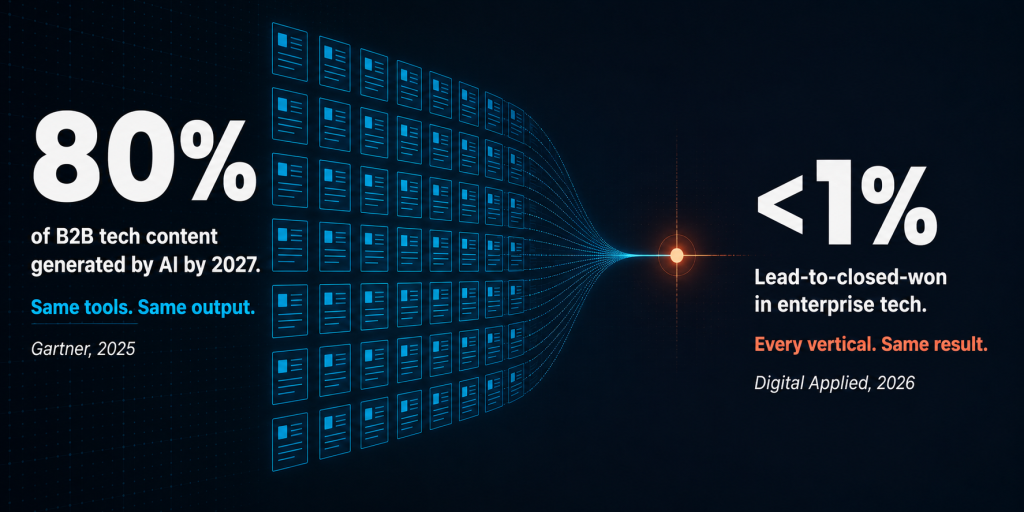
Those two numbers together tell the whole story. More content, produced faster, by better tools — and the commercial outcome has flatlined. Because the problem was never production capacity. It was always whether anyone had something worth saying.
And now AI has made this worse in a specific way. By 2027, 80% of B2B product content will be AI-generated. Which means the sea of sameness is about to become an ocean. Every company will produce more content, faster, at higher visual quality — and it will all look and sound exactly the same. The tool doesn’t have a point of view. It just produces the category average, efficiently.
“In a flood of AI-generated noise, human conviction is the rarest signal.”
What’s the answer? It’s not a rebrand. I want to be clear about that because the moment someone says “brand” in an enterprise tech marketing meeting, the room hears “logo change, 18 months, seven figures.” That’s a rebrand. And most enterprise tech companies don’t need one.
What they need is the story that was always there, finally being told out loud. The one truth the company actually owns that no competitor can claim by updating their roadmap. Something specific enough to be traceable back to this company and no other.

That’s the brief. One insight. One idea built around it. 90 days to run it across everything the marketing team already produces. Not instead of the pipeline campaigns — alongside them, making every one of them work harder.
The brands that will define enterprise tech in the next three years are not the ones with the biggest budgets or the most AI capability. They’re the ones that figured out, in 2026, that everyone else was saying the same thing — and decided to say something else instead.
The R&D lab figured this out a long time ago. The brief for innovation isn’t “do what everyone else has done, but slightly better.” It’s “find the thing nobody else has found yet, and bet on it.” Marketing deserves the same brief.