

 by
by Who Wrote the Score? Inside the 2026 Battle Over AI Music in Film and Advertising
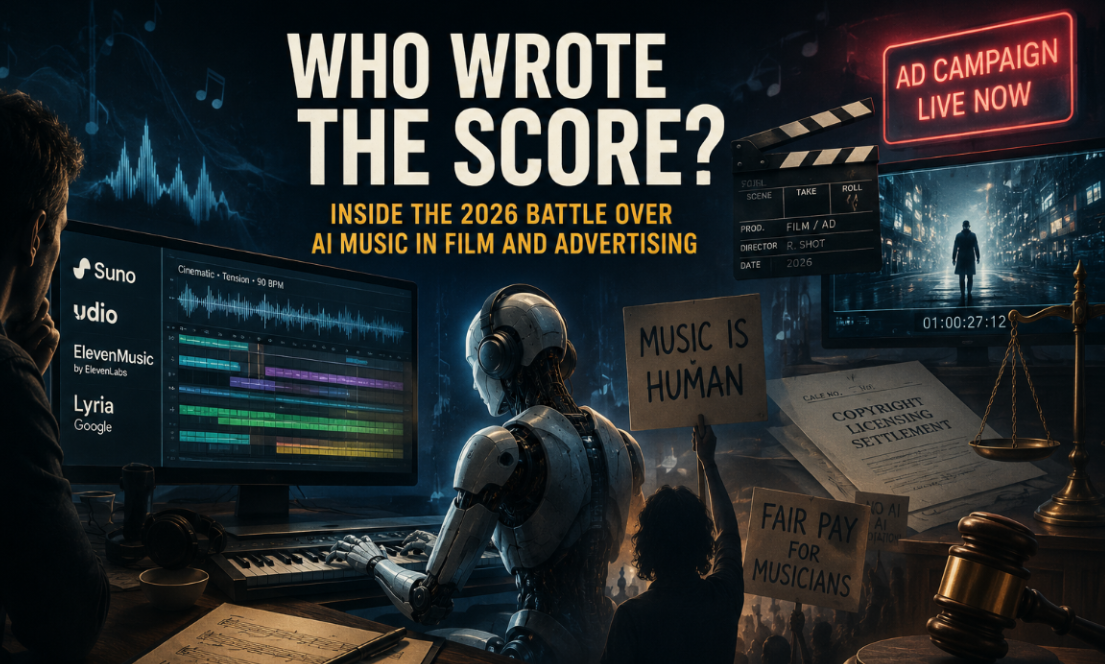
Eighteen months ago, “AI music” mostly meant novelty songs and copyright lawsuits. In 2026, it means a licensed track from ElevenLabs playing under a Super Bowl-adjacent ad, a Suno-generated cue temp-tracking a Netflix trailer before a composer ever opens a session, and a musicians’ union suing record labels over who gets paid when a machine writes the melody. The technology moved from novelty to infrastructure faster than the industry could agree on the rules — and the fallout is now playing out in courtrooms, ad agencies, and scoring stages at the same time.
The Toolbox: Suno, Udio, ElevenLabs Music, and Google’s Lyria
Four names dominate the generative-music conversation this year. Suno’s v5 model generates full songs — vocals, instrumentation, mix — from a text prompt in seconds, and remains the most widely used consumer tool despite its legal baggage. Udio, once Suno’s closest rival on quality, settled its lawsuit with Universal Music Group in October 2025 and emerged as what industry press now calls a “walled garden”: users can generate tracks, but exporting or downloading them for commercial use is restricted, blunting Udio’s usefulness for professional production work.
ElevenLabs took a different route. In April 2026 it folded its music tools into a standalone platform called ElevenMusic, explicitly marketed as a “fully licensed” alternative built on deals with the rights-management group Merlin, the publisher Kobalt, and distributor Believe. The pitch to agencies and studios is legal certainty: over 4,000 independent artists are represented in its catalog, and ElevenLabs says it has already paid out more than $11 million to creators through its adjacent voice-licensing business, with music payouts following the same model.
Google’s contribution is aimed less at consumers and more at production pipelines. Lyria — now on version 3.5, alongside the low-latency Lyria RealTime model — is available through Vertex AI for enterprise customers, positioning it as a backend component agencies and studios can plug into existing creative software rather than a standalone app. That enterprise framing matters: it’s the version most likely to show up inside ad-tech and post-production tools rather than in a musician’s browser tab.
How Composers and Agencies Actually Use These Tools
The reality on the ground is less “AI replaces composer” and more “AI compresses the front half of the process.” Ad agencies use tools like Soundverse and Suno to generate dozens of instrumental variations for short-form and social ads in minutes — testing tempo, genre, and mood against a storyboard before committing budget to a human composer or licensed track. For brand campaigns with fast turnaround and thin budgets, an AI-generated instrumental bed is increasingly the default first draft, not the exception.
In film and prestige television, the pattern looks different: AI tools show up earliest as temp-track generators. Editors and music supervisors use generative models to quickly mock up a scene’s emotional shape — tension, tempo, instrumentation — before a composer scores the final cue, replacing what used to be a search through stock-music libraries. Composers who’ve spoken publicly about the tools describe them as useful for ideation and mood-boarding but still unreliable for the structural, cue-to-picture precision that a director needs in a final mix — the kind of frame-accurate emotional timing that has traditionally justified a composer’s fee.
The Licensing Wars: Labels vs. AI Startups
The legal landscape shifted dramatically in the past year. Suno reached a settlement with Warner Music in November 2025, agreeing to retire every model trained on unlicensed material, launch new ones trained exclusively on licensed catalog, and — notably — acquire Warner’s ticketing platform Songkick as part of the deal. The settlement also tightened what free and paid users can do: unlimited free downloads are gone, and paid tiers now carry monthly caps.
Universal Music Group struck its own deal with Udio the previous month, but on much stricter terms — the resulting product can’t export generated audio for outside use, which is why industry observers describe it as commercially neutered compared to Suno.
Not every major label has settled. As of this spring, Universal and Sony remain in active litigation against Suno, with talks reportedly stalled over licensing fees and, according to sources close to the case, potential equity stakes in the AI company itself — labels want a piece of the business Suno built partly on their catalogs, not just a royalty check.
Perhaps the most pointed fight isn’t between labels and AI startups at all, but between labels and the artists whose work trained these systems. The Musicians’ Union has sued major labels directly, arguing that when labels struck AI licensing settlements, they didn’t pass artists’ contractual share of the resulting payouts. It’s a preview of a fight likely to recur every time a label monetizes catalog access to an AI company without renegotiating artist contracts.
Composers and Musicians Push Back
Reaction from working musicians has ranged from cautious engagement to outright protest. In the UK, musicians released a “silent album” in early 2025 to protest proposed changes to AI copyright rules, a stunt that helped keep the issue in the political conversation through 2026. SAG-AFTRA separately reached an agreement with record labels establishing AI protections for performers, an early template for how unions are trying to build consent and compensation into AI music deals before the technology gets further ahead of contracts.
For film composers specifically, the anxiety is less about being replaced outright and more about the low end of the market — trailer cues, library music, low-budget indie scores — being the first to go generative, compressing the entry-level work that used to sustain emerging composers before they could land bigger scoring jobs.
Where This Leaves the Industry
By late 2026, AI music generation has settled into an uneasy but functional split: agencies lean on it for speed and volume in advertising, studios use it as a pre-visualization tool rather than a final product, and the legal fights are less about whether AI music is allowed and more about who gets paid when it is. The Suno-Warner and UMG-Udio deals suggest the major labels have decided licensing beats litigation — but with Sony and Universal still fighting Suno, and musicians now suing their own labels over the proceeds, the money trail is far from settled. The tools are already inside the workflow. The contracts are still catching up.
Sources
- ElevenLabs officially launches ElevenMusic as AI music creation and streaming platform with licensed remix model — Music Business Worldwide
- ElevenLabs launches ElevenMusic as ‘not just a listening app’ — Music Ally
- Suno and UMG/Sony licensing stalemate, 2026 status — Happycapy Guide
- What Do the Suno and Udio Licensing Deals Mean for the Future of AI Music? — Billboard
- Launch, Train, Settle: How Suno And Udio’s Licensing Deals Made Copyright Infringement Profitable — Forbes
- Musicians’ Union Sues Major Labels for Artists’ Share of AI Song Generator Settlement Money — The Hollywood Reporter
- Musicians union sues major record labels over AI licensing — Cornell Catherwood Library
- SAG-AFTRA, record labels reach deal over AI protections for artists — AOL
- British musicians release silent album to protest plans to let AI use their work — Fox News
- Google Cloud: Expanding generative media for enterprise on Vertex AI
- Lyria 3.5 — Google DeepMind
- How AI Music Is Transforming Advertising and Brand Identity in 2026 — Soundverse
- AI Music for Film Scoring: How AI is Shaping Cinematic Soundtracks in 2026 — Soundverse